How to Use Untangle MINI Self-Serve with a Partner for Retirement Planning
Planning for retirement as a couple is a great way to build a shared framework—and a shared language—for talking about your money and your priorities.
We strongly believe that every person should have their own financial plan. And if you have a partner, it can also be incredibly useful to have a joint financial plan that shows what your household looks like together.
Untangle MINI Self Serve can help you create that shared picture, but you’ll need to enter some information a little differently when you’re planning for two people.
The key is to think of the plan as one household view, while making sure the assumptions about age, retirement benefits, income and expenses reflect both people.
There are seven changes to make.

Start with one household plan
When planning with a partner, you can create two completely separate retirement plans, or you can create one household plan.
A household plan looks at the money coming in, the money already committed, and your retirement income as part of the same picture.
In Untangle MINI Self Serve, that means entering your information so the plan reflects your combined Now Money and Future Money.
It’s a great way to create a shared framework and a common language for talking about money together.
SISTERLY ADVICE: If one person has most of the household income or assets, it’s especially important to understand what a solo plan looks like for the person with less money. A joint plan can tell you whether the household works—but a solo plan can help you understand what each person’s financial picture looks like on their own.
Get the age assumption right
This is the trickiest part of using Untangle MINI Self Serve with a partner.
Untangle MINI Self Serve starts by assuming that you’ll retire at 65. We do this intentionally. Most people would like to retire earlier, but when they first start using MINI, they haven’t yet seen how things like investment returns, inflation and Committed Money affect what’s possible. Starting at 65 gives you a realistic baseline before you start experimenting with earlier retirement.
Once you’ve completed the process and reached your dashboard, you can change your retirement age and see what happens to your plan.
So whose age should you enter?
When you’re setting up the initial plan, your current age and life expectancy should correspond to the same person.
Because MINI initially assumes retirement at 65, the current age you enter determines how many years MINI thinks you have until retirement.
For example, imagine one partner is 60 and the other is 55, and you want to start by looking at what happens if the household continues working until the older partner reaches 65.
You could use the 60-year-old partner’s information:
Current age: 60
Initial retirement age: 65
Years until retirement: 5
The important thing is that the age you enter produces the correct number of years until the retirement age you’re modelling.
You should also make sure the life expectancy corresponds to the same person whose age you entered. Don’t combine one partner’s current age with the other partner’s life expectancy.


Ready to test an earlier retirement?
Once you’ve completed the MINI process, head to your dashboard. That’s where you can start playing with retirement age.
This is where things get interesting.
You can change the retirement age and see what happens to your plan if you retire earlier—or later. Try a few different ages and see how the numbers change.
The goal isn’t to find one magical retirement age. It’s to understand what you’d need to change to make an earlier retirement possible.

If you retire at different times
If one partner plans to stop working before the other, a single household plan can’t perfectly model every detail of that transition.
Start by looking at the retirement timing that creates the biggest change in household income.
For example, if the higher-earning partner plans to retire first and that creates a significant drop in household income, it can be useful to test that scenario first.
Ask yourself:
Does that person earn a large share of household income?
Does their pension begin when they retire?
Will they start drawing from savings when they stop working?
Does the household’s spending change when they stop working?
You can then adjust the retirement age from the dashboard and test different scenarios.
The goal isn’t to find one magical set of numbers. It’s to understand what happens when the assumptions change.
Combine your incomes
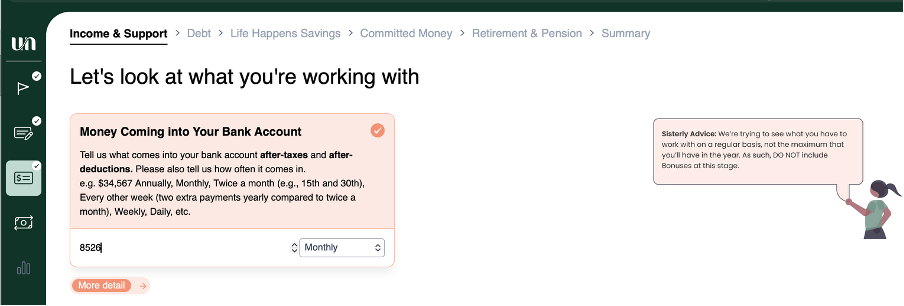
When you’re creating a household plan, include income from both people.
Make sure the income you enter reflects what you actually have available to spend: after taxes and other deductions.
Think of it as the money that actually lands in your hands.
Combine all after-tax and after-deduction income from both partners.
Combine Your Committed Money Costs
Committed Money is the money that’s already spoken for before you’ve even gotten out of bed.
It includes the costs created by previous choices and commitments, such as:
Housing
Transportation
Insurance
Medication
Memberships
Subscriptions
Other ongoing obligations
When using Untangle MINI Self Serve with a partner, combine the Committed Money costs for both people.
That gives you a much more realistic picture of the household’s ongoing financial commitments.
Combine all Committed Money costs for both partners.

Combine Your Debts
Make sure the household plan includes debts belonging to both partners.
That means including things like:
Mortgages
Lines of credit
Student loans
Credit cards
Car loans
Other outstanding debt
Combine all debts in the household’s MINI plan.

Combine Pension and Matching Program Information
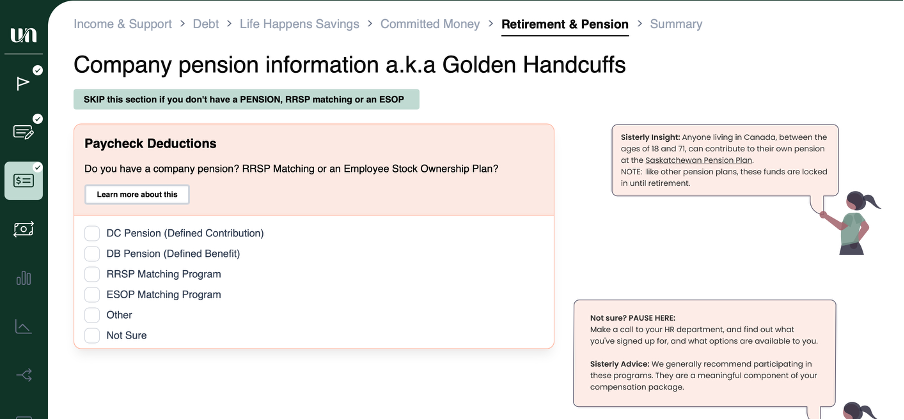
Retirement income can look very different for two people, so make sure you account for both partners’ pensions and employer matching programs where appropriate.
If you’re using the younger partner’s information to establish the timing of the plan, include relevant pensions and matching programs for both people.
If a pension or matching program won’t be available during the period you’re modelling, don’t include it prematurely.
For example, if you’re modelling the household five years from now and one partner’s pension won’t start until later, you don’t want to make the household look more financially comfortable than it actually will be during those years.
Include the pensions and matching programs that are relevant to the period you’re modelling.
Adjust CPP Assumptions for Both People
CPP is individual. Each partner has their own CPP entitlement, so your amounts may be quite different.
Untangle MINI Self Serve starts with the most recent average CPP payment received by people in Canada, and adjusts that amount for inflation as part of the planning calculation.
For a quick household estimate, you can simply double the CPP amount if you and your partner have reasonably similar circumstances.
But if your situations are different, it’s worth adjusting the number.
For example:
Higher-than-average income: You may want to increase the CPP estimate.
Lower CPP contribution history: You may want to decrease it.
A significant amount of time spent outside Canada: You may want to decrease the estimate.
Different circumstances for each partner: Estimate each person’s CPP separately and combine the amounts.
You don’t need to get this number perfect. The goal is to give MINI a reasonable starting point for your household retirement income.
SISTERLY ADVICE: If you’re just trying to get a quick sense of whether your household retirement plan is in the right ballpark, doubling the CPP estimate is a perfectly reasonable place to start. You can always refine it later.

Adjust OAS payment assumptions with the household in mind
OAS is also an individual benefit, so each partner may receive a different amount.
Untangle MINI Self Serve starts with the most recent average OAS payment received by people in Canada, and adjusts that amount for inflation as part of the planning calculation.
For a quick household estimate, you can simply double the OAS amount to represent two people.
But you may want to adjust the number if your circumstances are different from the average.
For example:
If you have spent a significant amount of time outside Canada: You may want to decrease the OAS estimate.
If your circumstances suggest you may receive less than the average: Adjust the amount downward.
If you expect a different benefit based on your circumstances: Use your best available estimate instead.
Again, this doesn’t need to be perfect. We’re building a planning scenario, not predicting your exact government benefits decades from now.
The goal is to use a reasonable household estimate and then see how the plan behaves.
One important thing to remember
If one partner is older than the other, the OAS benefit may not start at exactly the same time. And, if one partner has a different residency history, their benefit may be different too.
For a first-pass plan, combining the two estimates is fine. If the result is close to the line, that’s a good reason to refine the assumptions and take a closer look.
Common partner-planning mistakes to avoid
A few small input errors can make a surprisingly big difference to your plan.
Mixing up the ages
One of the easiest mistakes is combining one partner’s current age with assumptions that belong to the other partner.
Remember: Untangle MINI assumes retirement at 65.
So the current age you enter determines how many years MINI thinks you have until retirement.
For example, if you enter a current age of 35, MINI assumes there are 30 years until retirement at 65.
If the household is actually planning to retire in 28 years, that age assumption won’t give you the right picture.
The fix is simple: make sure the age you enter produces the correct number of years until the retirement point you’re trying to model.
And make sure the life expectancy you enter belongs to that same person.
Including only shared bills
Another common mistake is including only expenses that are literally shared.
Your household plan should include the financial commitments of both people, not just the bills that arrive in both names.
If you intentionally want to look at only one person’s finances, create a separate solo plan instead.
Treating temporary income like lifetime income
It’s also easy to include income that may not last forever.
Temporary income shouldn’t automatically be treated like lifetime income.
Start with the income you can reasonably count on. Then add temporary income and see how much difference it makes.
This can help you make a much more useful decision about that income.
If your plan only works because of income that is temporary—and there’s no obvious way to extend it—it may be time to look at reducing some Committed Money costs or changing another assumption.
And remember: you can always adjust your numbers and run another scenario.
What a good partner setup looks like
A good partner setup in Untangle MINI Self Serve should be clear enough that you can explain it to each other.
If someone asked, “How did you build this plan?” you should be able to answer in plain language.
You should know:
Whose age you used—and why
How many years until retirement the plan is modelling
Whose life expectancy you used
Which income sources were combined
Which Committed Money costs were included
How CPP was estimated for both people
How OAS was estimated for both people
Which pensions and matching programs were included
Which assumptions you’re testing
The value of using MINI with a partner isn’t that it gives you one perfect answer.
It gives you a shared picture you can test.
You can turn two people’s ages, incomes, benefits and costs into one household planning view—and then start asking better questions.
What happens if we decide to retire earlier?
What happens if our spending changes?
What happens if one income disappears?
Retirement planning with a partner is rarely a one-and-done exercise.
Start with the clearest shared version you can build. Then test the assumptions that matter most.
Make a plan. Do things. Adjust. Repeat.
That’s how you turn retirement planning from a one-time calculation into an ongoing conversation.


Comments